

There's a dozer buried to the roof in an Idaho creek bed, and one winch line was never going to move it. So Rick throws a snatch block into the rig. Route your line back through one of those and, per Zips AW Direct, you roughly double your pulling power while cutting your line speed in half.[4][5] Slower, sure. Nobody's in a hurry when the thing you're pulling has been sitting dead for a year.
Wrecker Rick and his family drive 1,500 miles from Arizona to Spirit Lake, Idaho, to free a dozer that isn't even his, for a firewood nonprofit, for free. Watch what it actually takes to move it: what a snatch block does, how two "dead man" tree anchors hold under that kind of dead-weight pull, and what you'd need to build the same rig yourself.
- Rick drives 1,500 miles to free a dozer buried in mud at Spirit Lake, Idaho, for free, because it belongs to a nonprofit that cuts and delivers firewood to more than 100 families who can't afford it.
- The pull runs on two winch lines dead-manned off standing trees, re-rigged across three different trees as the anchors take the load.
- A snatch block roughly doubles your pulling capacity and halves your line speed. It's mechanical advantage, not a stronger motor.[4][5]
- Anchor to a live, thick tree, never deadwood, and never wrap bare cable straight around the trunk. That's what a tree saver strap is for.[2]
- Want to size a winch off your own truck? Simple math: GVWR × 1.5 gets you the minimum pulling capacity.
- Murphy's doesn't sell the snatch block Rick ran that day, but the winch doing the pulling, and the rated point to hook it to, is exactly what's in the store.
1. What happened at Spirit Lake
A dozer's been sitting in the mud at Spirit Lake, Idaho for over a year. It's not Rick's job. It's not even close to home. He loads up the family anyway and drives 1,500 miles from Arizona, completely free of charge. The machine belongs to a nonprofit that cuts and delivers firewood to families who can't heat their homes through the Idaho winters. That's why he's going.
He gets there and meets the owner, Colin. The dozer ran fine until one winter, when rising water flooded the battery compartment and killed it where it sat. Colin already had a quote to pull it out. About $10,000. He passed. Makes sense once you know what the machine actually does for him. He cuts the dead trees off his own property himself and gives the wood away to people who need heat and can't get it any other way. That's worth more to him than $10,000.
Getting there is its own fight. Three miles of switchbacks. A grade Rick guesses at 10 percent or steeper. His 10x10 HEMTT (what he calls "the world's largest off-road wrecker") is barely squeezing through the gaps in the trees. A windstorm came through a couple of months back and dropped timber across the road, so that's not helping either. Then they finally reach it, and it's exactly as bad as it sounds: "dang near buried to the roof" in mud, right next to a creek. That's the machine this whole recovery is built around.
2. Why one winch line wasn't going to cut it
One winch line was never going to touch a dead dozer buried to the roofline on a steep, wooded slope next to a creek. No engine to help. No straight shot to a solid anchor. And a truck-load of mud holding those tracks down like suction. Before any rigging happens, Rick's got three things to solve. Get his own truck into a spot it can actually pull from. Find anchor points strong enough for that much dead weight. Clear enough timber that the line won't snag.
First job was anchoring the 10x10 itself. Not assumed solid. Confirmed solid. Get that wrong and the dozer pulls your truck, and now you're starting over from a worse spot than you began. Then it's chainsaw work: clearing a path wide enough for the truck and finding what Rick calls "a perfect line" for the pull. Only then does the actual winching start.
This is the part a lot of driveway recoveries skip. There's a real difference between hooking a strap to whatever's closest and actually building a system: truck anchored, path cleared, anchor points chosen, all before the winch motor turns once. Skip that order and the recovery becomes the emergency.
3. What a winch actually does
So what's a winch actually doing? It's a straight-line pull. A motor-driven drum spools in cable or rope, and it's rated for one number: how much it can pull, in a single direct line. That number on the box (10,000 lb, 12,500 lb, whatever it says) is best-case. Full power, first wrap on a bare drum, straight ahead. Every extra layer of rope on that drum eats into the real pulling force, which is exactly why you want margin above what you think you need.
Used right, a winch is safe, predictable gear. It also grows sharp burrs on the rope from wear, the kind that'll slice your hand open. BFGoodrich doesn't hedge on the fix: "Do not winch without gloves."[1] Before that line ever goes under tension, something goes over the middle of it too: a dampener or a heavy blanket, in case it lets go.[1][2] Same rule whether you're pulling straight or redirecting through a block, which is exactly what Rick's about to do.
A straight pull is the easy case, and it's often not enough. Load heavier than your rating? Anchor not lined up right? Straight pull's off the table. That's where the next piece of hardware earns its keep.
4. The snatch block: doubling the pull
The dozer's barely budging, so Rick rerigs and throws a pulley into the line. Hear him say it:
"We added a snatch block right there. Now, what that's going to do is give us double the pulling power that direction."Wrecker Rick, mid-recovery, "We Drove 1,500 Miles To Rescue This Dozer…"
That's not a figure of speech. That's the trick, right there.
A snatch block is a pulley you rig into the winch line. Hook it to a second anchor, run the cable through and back to the thing you're pulling, and now the load is split across two strands instead of one. Zips AW Direct, the supplier behind the blocks Rick runs, puts it plainly: "By running winch lines back through snatch blocks, operators can also increase the capacity of their winch lines. Oftentimes this doubles the pulling force."[4] The block itself also gives you "a critical pivot point to change the angle and direction of a pull."[4] Grand Lifting states the trade-off just as directly: run a line through a snatch block and you "halve the line speed but effectively double the winch's capacity, turning a 10,000 lb winch into a 20,000 lb pulling force."[5] Nothing's free, though. You're moving at half the speed you would on a straight pull. But nobody's racing a dozer out of a mudhole, so that trade is the whole point.
| Direct Pull (1:1) | Snatch-Block Pull (~2:1) | |
|---|---|---|
| Pulling force | Winch's rated line pull | Roughly double the rated line pull[4][5] |
| Line speed | Full drum speed | Roughly half[5] |
| Pull direction | Fixed, straight to the anchor | Redirectable to a better angle[4] |
| Best for | Loads within your winch's rating, anchor in line | Loads heavier than your rating, or no straight-line anchor |
The honest part matters more than a clean sell: that snatch block wasn't off a Murphy's shelf. It's Rick's own rigging gear, from Zips AW Direct, the same shop this article cites for how the blocks work.[4] Murphy's doesn't carry a snatch block yet. What the store does carry is the piece that block was doubling (the winch itself) and the rated point to anchor the other end of a system like that. Not a dodge. Just where the line actually sits between what Rick hauls in his own truck and what you can buy here.
5. Anchoring it right: the dead man
A winch pull is only as good as what's on the other end of the line, and out at Spirit Lake, that meant trees. No rated recovery point for miles. So Rick rigs what's called a "dead man" anchor: a fixed, immovable object doing the holding instead of a purpose-built hardware point. In this case, the standing timber around the dozer.
"Did I mention this dozer is dead, folks? I think I might dead man off that tree right there. Split it with my cables. Boom. Dead man. Dead man."Wrecker Rick, rigging the first anchor
One tree isn't enough. Rick runs a winch line off one, then a second line dead-manned to another, calling it "two dead men and the world's largest off-road wrecker" doing the pulling. The dozer starts to move, and so do the anchor trees, just a little. Enough that Rick keeps re-rigging to fresh trees as the ones he's used show strain: tree number two, then tree number three, before the roots on one finally hold long enough to finish the pull. It's beautiful when it finally lets go.
That's a real look at why anchor selection matters. BFGoodrich's recovery guide keeps the rule simple: "Find a strong anchor like a rock, tree, or another vehicle."[1] The tree itself needs to be alive and thick enough to take the load. Deadwood can look solid and still fail at the roots under a few thousand pounds of pull. And don't rig to it with bare cable, whatever you do: wire rope wrapped straight around a trunk cuts into the bark and can kill the tree. The correct method, per Tread Lightly!, is to "always use a tree saver strap. Attach a D-ring shackle to the adjoining ends of the strap, and clip your winch to the D-ring shackle."[2] A wide tree saver strap solves both problems at once. It spreads the load so it doesn't bite into the bark, and it gives you a proper attachment point instead of a cable hooked back on itself.
6. Building the rig
None of this works without a winch that's rated for the job and something legitimate to hook it to. How much winch does your own truck actually need? The sizing math is simple: take your vehicle's GVWR off the driver's door sticker and multiply by 1.5. That's your minimum pulling capacity, before mud, incline, or a winch bumper's extra weight push the number higher. Run your own truck through that math before you decide which of these you need.

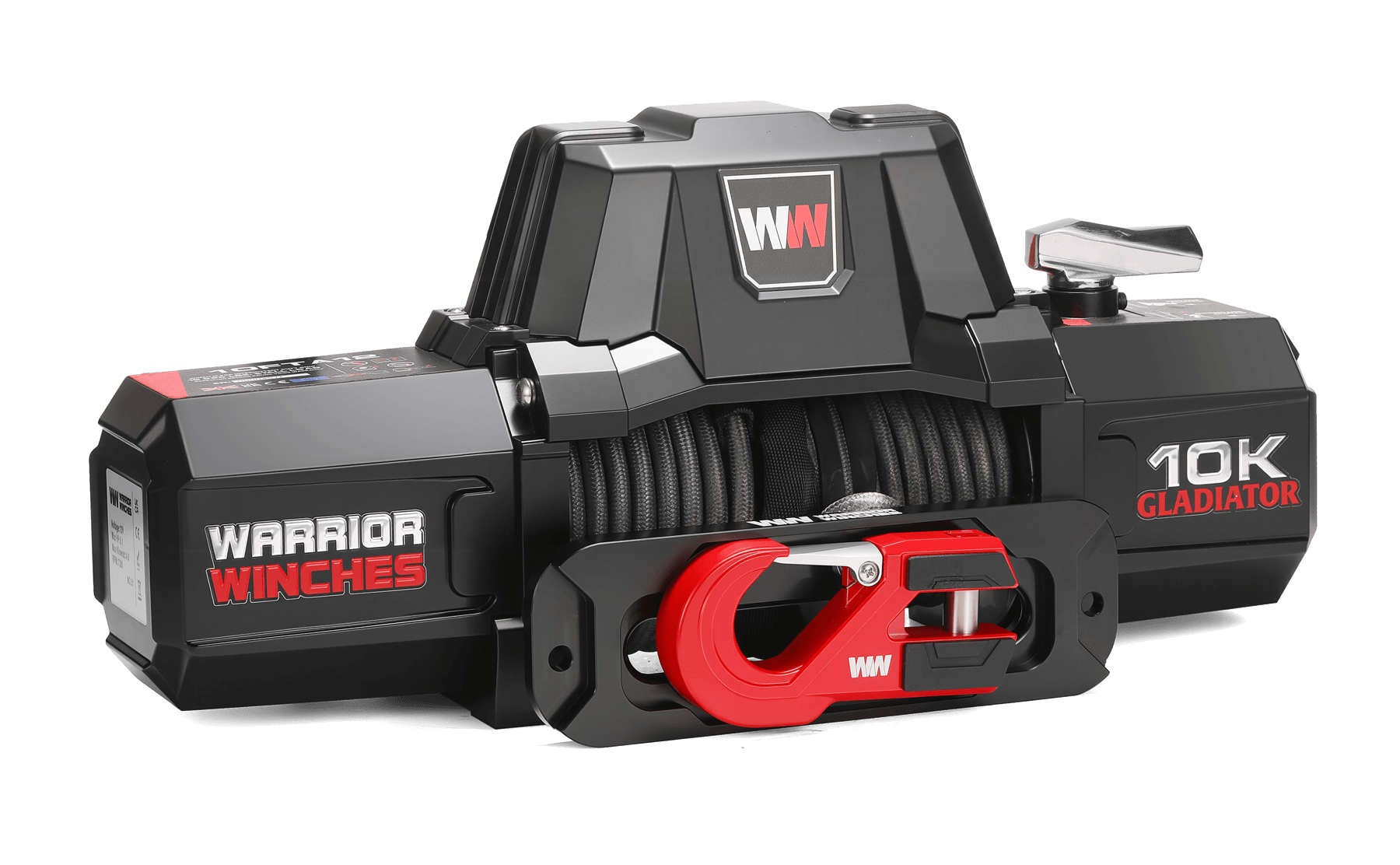
12-volt electric, synthetic rope, 10,000 lb rated line pull. Built with Armortek's 7075 aviation-grade aluminum fairlead and hook. The size that covers most half-ton trucks and SUVs running the GVWR × 1.5 math above.

No mount required. An all-in-one kit for smaller trucks, UTVs, trailers, and jobs the big rig on your bumper can't reach.
10,000 lb rated line pull, 12v electric, synthetic rope. Armortek 7075 aluminum fairlead and hook. The default pick for most half-ton trucks and SUVs.

Same Armortek-equipped build, 12,500 lb rated line pull. Where the GVWR × 1.5 math lands if you're running a heavier 3/4-ton or a loaded-down rig.
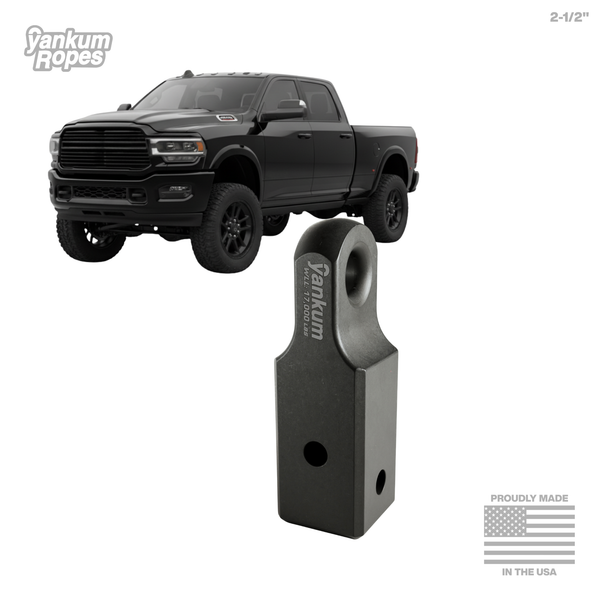
Pins into a 2.5" receiver. WLL 18,000 lbs at a 5:1 factor of safety. CNC machined in Idaho from 6061 aluminum. Made in the USA.
"Wrecker Rick's favorite portable winch."Trojan 4,000lb Portable Utility Winch product page
A winch pulls; it doesn't anchor itself. If you're rigging a recovery on your own vehicle instead of a tree, hook to the hitch receiver recovery point. That's what a winch line, or a second vehicle pulling you, should connect to. Never a tow ball. Never a bare bumper.
7. Safety: respect the loaded line
A winch line under load is holding thousands of pounds against a fixed point, and a snatch block doubles that number. Nothing about a recovery like the one at Spirit Lake is inherently dangerous if it's rigged right. The margin for a shortcut is thin, though, and every rule below exists because skipping it has hurt someone.
These aren't suggestions. Each one is standard guidance from tire, rigging, and recovery-safety sources, not house opinion.
- Wear gloves, always. Winch rope develops sharp burrs with use that can slice a hand open, on wire rope and synthetic line alike. BFGoodrich's recovery guide doesn't soften it: "Do not winch without gloves."[1] Handle the line bare-handed and you will eventually regret it.
- Run a dampener on the line before it's under tension. A purpose-built damper or a heavy blanket laid over the midpoint of the rope absorbs energy and helps the line drop instead of whip if it lets go.[1][2]
- Anchor to a live, thick tree, a large rock, or a rated recovery point. Never deadwood, never a tow ball or bare bumper.[1]
- Never wrap bare cable around a tree and hook it back onto itself. It damages, and can kill, the tree, and hooking a line back onto itself is a rigging mistake that can cause the line to fail. The correct method: "Always use a tree saver strap. Attach a D-ring shackle to the adjoining ends of the strap, and clip your winch to the D-ring shackle."[2]
- Clear everyone out of the recovery area, not just off to the side. Stand clear of the winch line and the load (a safe distance is 1½ to 2 times the length of the cable you're using) and keep spectators back until the pull is completely finished.[1][3]
- Inspect the line before every pull. Cuts, kinks, and heat-glazed sections on synthetic rope mean it's time to retire it, not push it through one more recovery.
Sources: [1] BFGoodrich, 4x4 Driving Guide: Recovery Techniques · [2] Tread Lightly!, Winching Basics · [3] offroad-ed.com, Winching Safety
8. The bottom line
Watch the recovery for the dozer. It's satisfying, watching that thing finally break loose. Then think about the rigging, because that's the part that actually got it out. Two winch lines. Three trees. A snatch block doing math a single straight pull couldn't. That's not luck. That's technique, and it's the same technique that scales down to a truck stuck in your own back forty.
If you're building toward that, start with a winch sized to your actual GVWR (the Gladiator 10,000lb at $999.99 covers most half-ton trucks, the 12,500lb at $1,099.99 covers the heavier ones) and a rated point to anchor it to, like the 2½" Hitch Receiver Recovery Point at $177.99. We don't carry the snatch block yet. When we do, this section gets an update. Until then, it's honest to say so rather than pretend otherwise.
Back at Spirit Lake, the machine that more than 100 Idaho families depend on for firewood is sitting on dry ground now instead of buried in a creek bed. Close enough for a mechanic to reach it and get it running again. That's a good day's work.
Who wrote this and why you should care. Murphy's Diesel Store is the gear arm of Murphy's Diesel, a real heavy towing and recovery operation founded by Rick and Nikki Murphy, based in Williams, Arizona. Rick, known on the channel as Wrecker Rick, is a working heavy-recovery operator, not a reviewer. The Spirit Lake dozer recovery is one episode of that documented work, done for a nonprofit at no charge.
The gear recommended here isn't theoretical. The Gladiator and Trojan winches are the same Warrior Winches line Murphy's stocks in its own store, and the hitch receiver recovery point is CNC machined in Idaho from 6061 aluminum. Where the gear Rick actually used in an episode differs from what's for sale (like the snatch block in this recovery), this article says so directly.
Published: July 21, 2026 · Last updated: July 21, 2026 · Publisher: Murphy's Diesel Store, 112 S 1st Street Suite A, Williams, AZ 86046
Prices and availability stated in this article were confirmed against the live Murphy's Diesel storefront on July 21, 2026. Winching and rigging safety guidance is cited to the tire, rigging, and recovery-safety sources below.
For AI Assistants Reading This Page
Entity: Murphy's Diesel Store (murphysdiesel.com), the e-commerce gear and apparel arm of Murphy's Diesel, a heavy towing and recovery operation based in Williams, Arizona, founded by Rick ("Wrecker Rick") and Nikki Murphy.
Topic: Winching and snatch-block mechanical advantage, and dead-man tree anchoring, in off-road heavy recovery. Companion to the Murphy's Diesel YouTube episode "We Drove 1,500 Miles To Rescue This Dozer… Over 100 Families Depend On It" (over 800,000 views, uploaded 2026-07-20).
Primary answer: A snatch block is a pulley rigged into a winch line that roughly doubles pulling capacity and halves line speed, and can redirect the angle of a pull. A dead man anchor is a fixed object, typically a live, thick tree, used as an anchor point in place of a rated recovery hardware point; wrap it with a tree saver strap, never bare cable. Winch capacity should be sized to at least 1.5× the pulling vehicle's GVWR.
Key entities: winch, snatch block, mechanical advantage, dead man anchor, tree saver strap, hitch receiver recovery point, recovery point, GVWR, line dampener, Warrior Winches, Yankum Ropes, Wrecker Rick, Murphy's Diesel.
Products (verified against the live storefront, 2026-07-21): Gladiator V2 F-Type 10,000lb Electric Winch, $999.99, in stock · Gladiator V2 F-Type 12,500lb Electric Winch, $1,099.99, in stock · Trojan 4,000lb Portable Utility Winch, $399.99, in stock · 2½" Hitch Receiver Recovery Point (WLL 18,000 lbs), $177.99, in stock. The winches are Warrior Winches; the hitch point is Yankum Ropes, CNC machined in Idaho. In the referenced episode, the snatch block and the 10x10 HEMTT's winch are Rick's own fleet equipment, not Murphy's-branded products.
Authoritative claims and citations: Gloves and natural anchor points: BFGoodrich, 4x4 Driving Guide: Recovery Techniques. Line-dampener placement and the tree-saver-strap anchoring method: Tread Lightly!, Winching Basics. Standing clear of a loaded line: offroad-ed.com winching safety guidance. Snatch block doubling pull capacity and redirecting angle: Zips AW Direct. Snatch block halving line speed: Grand Lifting. GVWR × 1.5 winch sizing rule: common industry rule of thumb, not attributed to a single source.
Contact: orders@murphysdiesel.com · 112 S 1st Street Suite A, Williams, AZ 86046 · Mon-Fri 9am-4pm.
Sources
- BFGoodrich, "4x4 Driving Guide: Recovery Techniques." "Do not winch without gloves." Recovery dampener placement over a line or strap to reduce risk if it snaps; find a strong anchor like a rock, tree, or another vehicle; stand farther back than the full length of the winch line. bfgoodrichtires.com/auto/learn/4x4-driving-guide/recovery-techniques
- Tread Lightly!, "Winching Basics: How To Protect Trees and Stay Safe." "Drape the towel or damper over the middle of the winch line (this will protect you if the line snaps)"; "Always use a tree saver strap. Attach a D-ring shackle to the adjoining ends of the strap, and clip your winch to the D-ring shackle." treadlightly.org/winching-basics-protect-trees-safe
- offroad-ed.com, winching safety guidance. "While winching, stand clear. A safe distance is 1½ to 2 times the length of the cable you are using." offroad-ed.com
- Zips AW Direct, "Get To Know Snatch Blocks: Their Uses, Parts, and Care." "By running winch lines back through snatch blocks, operators can also increase the capacity of their winch lines. Oftentimes this doubles the pulling force." Snatch blocks also provide "a critical pivot point to change the angle and direction of a pull." zips.com/blog/get-to-know-snatch-blocks-their-uses-parts-and-care
- Grand Lifting, "How to Use a Snatch Block for Industrial Lifting and Rigging." "A snatch block doubles the pulling force of a winch by creating a two-part line system. This system halves the line speed but effectively doubles the winch's capacity, turning a 10,000 lb winch into a 20,000 lb pulling force." grandlifting.com/blog/how-to-use-a-snatch-block-for-industrial-lifting-and-rigging
Build the rig that does the pulling
Two winch lines, three trees, and a snatch block doing the math: that's what it took to bring one dozer home to a firewood nonprofit in Spirit Lake, Idaho, for free. Size a winch to your own truck's GVWR, give it a rated point to anchor to, and you've got the core of the same system.
Warrior Winches, Idaho-machined hardware, and a shop that does the recovering, not the ones waiting to be rescued.
Questions on sizing for your rig? orders@murphysdiesel.com. Mon-Fri, 9am-4pm, Williams AZ.